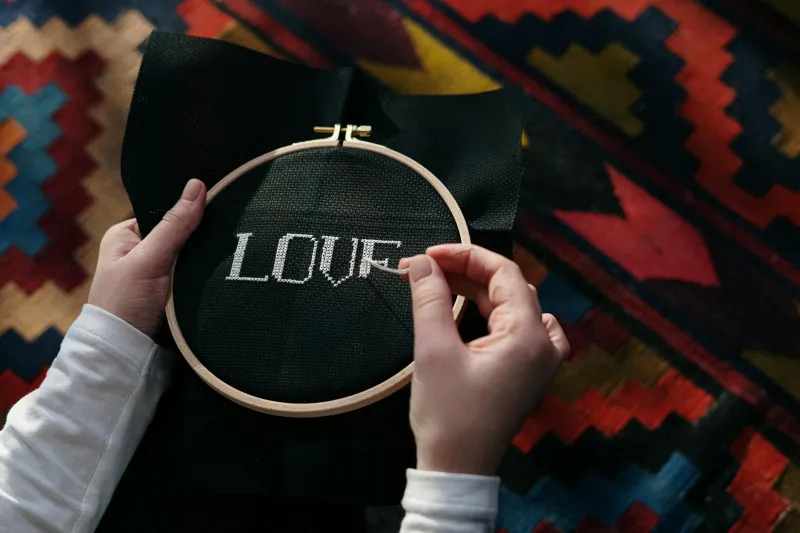
There's something magical happening in sitting rooms, studios, and craft corners across Britain. The gentle rhythm of needle through fabric is creating a quiet revolution, one stitch at a time. Embroidery, that most patient and personal of crafts, is experiencing what can only be described as its most vibrant chapter in decades.
A Craft Reborn
Walk into any independent craft shop from Cornwall to the Highlands, and you'll witness the same scene: embroidery hoops flying off shelves, threads in rainbow hues disappearing faster than they can be restocked, and beginners' classes with waiting lists stretching months ahead. This isn't just a trend—it's a movement that's weaving itself into the very fabric of contemporary British creativity.
The numbers tell their own story. The Royal School of Needlework reports a 300% increase in workshop applications over the past three years, whilst independent embroidery teachers across the UK describe demand that's "absolutely unprecedented." Sarah Mitchell, who runs The Stitching Circle in Bath, laughs when she recalls how she started with one evening class per month. "Now I'm running six classes a week and still turning people away. It's wonderful chaos."
Digital Threads, Timeless Craft
What's particularly fascinating about this renaissance is how seamlessly it bridges the ancient and the contemporary. Instagram accounts dedicated to British embroidery artists boast hundreds of thousands of followers, with hashtags like #UKEmbroidery and #BritishStitchers creating vibrant online communities where makers share techniques, celebrate each other's work, and offer gentle encouragement to newcomers.
Take Hannah Waldron, whose @wildwoodembroidery account has become a beacon for nature-inspired stitching. Based in the Yorkshire Dales, she transforms the British landscape into delicate thread paintings that capture everything from misty mornings to wildflower meadows. "Social media has allowed us to connect in ways our grandmothers' sewing circles never could," she explains. "I can share a technique with someone in Scotland at breakfast and receive inspiration from a maker in Devon by teatime."
Masters of the Modern Thread
Whilst newcomers are discovering the joy of their first French knots, established British embroiderers are pushing the boundaries of what the craft can achieve. Jessica Grady, whose contemporary pieces have graced the walls of the Victoria and Albert Museum, creates intricate works that challenge every preconception about embroidery being merely decorative.
Her latest commission—a stunning piece for a private collector in Mayfair—combines traditional goldwork techniques with modern abstract forms, creating something that feels both ancient and utterly contemporary. "Embroidery has always been about storytelling," Grady reflects. "What's changed is that we're now free to tell any story we choose, in any way we choose."
Meanwhile, in Edinburgh, the team at Dovecot Studios continues to prove that embroidery belongs in the highest echelons of fine art. Their collaborations with contemporary artists have resulted in pieces that blur the lines between craft and art, tradition and innovation.
The Healing Power of Slow Making
Perhaps the most beautiful aspect of embroidery's current moment is how it serves as an antidote to our increasingly frantic world. In an age of instant everything, the deliberate pace of embroidery offers something precious: time to breathe, think, and simply be present.
Dr. Rebecca Turner, who researches the therapeutic benefits of traditional crafts at the University of Bath, isn't surprised by embroidery's appeal. "There's compelling evidence that repetitive, creative activities like embroidery can significantly reduce anxiety and improve mental wellbeing," she explains. "But beyond the science, there's something profoundly satisfying about creating beauty with your own hands, stitch by careful stitch."
This meditative quality has found particular resonance during challenging times. Community groups across Britain have embraced embroidery as a way to connect and heal together. The Stitching Support Network, which began in Manchester and has spread nationwide, combines embroidery circles with mental health support, creating safe spaces where makers can share both stitches and stories.
Where Tradition Meets Tomorrow
What makes Britain's embroidery renaissance so special is how it honours the past whilst embracing the future. Traditional techniques passed down through generations sit comfortably alongside innovative approaches that would make our ancestors smile with recognition and surprise in equal measure.
The Royal School of Needlework, guardian of centuries-old techniques, now offers courses in contemporary embroidery alongside their famous goldwork classes. Students might spend their morning learning the same techniques used to create Tudor court dress, then dedicate their afternoon to developing a modern piece that speaks to today's world.
This blend of old and new is perfectly embodied by makers like Tom of Holland, whose hand-embroidered menswear has caught the attention of celebrities and fashion editors alike. His pieces take traditional British embroidery motifs—think thistles, roses, and oak leaves—and reimagine them for contemporary wardrobes, creating garments that are both heritage pieces and fashion statements.
The Future Looks Bright
As we look ahead, Britain's embroidery renaissance shows no signs of slowing. Independent craft schools are expanding their offerings, galleries are dedicating more space to textile arts, and a new generation of makers is ensuring that this ancient craft will continue to evolve and inspire.
What's most heartening is how this revival celebrates both individual creativity and community connection. Every stitch tells a story, every hoop holds hopes and dreams, and every finished piece represents hours of quiet contemplation and joyful making.
In a world that often feels fragmented, there's something deeply comforting about the way embroidery brings people together—across generations, across social media feeds, across the length and breadth of our beautiful, creative island. The needle's revival isn't just about craft; it's about community, creativity, and the enduring human need to make something beautiful with our own hands.
As one wise embroiderer recently shared online: "We're not just stitching fabric—we're stitching ourselves back together, one thread at a time." And isn't that the most beautiful story of all?