The Magic Begins at Dawn
There's something almost mystical about watching Sarah Henderson emerge from the morning mist on the North Yorkshire Moors, her wicker basket heavy with elderberries, her fingers already stained purple from the morning's harvest. She's not foraging for jam-making – she's hunting for colour.
"People think I'm a bit mad," she laughs, holding up a handful of what most would consider weeds. "But these bramble leaves? They'll give you the most incredible golden yellow. And this moss from the dry stone walls? Pure magic in the dye pot."
Sarah is one of Britain's growing tribe of natural dyers, artisans who've turned their backs on synthetic colours in favour of something far more profound – hues harvested directly from the landscapes they call home.
Where Chemistry Meets Poetry
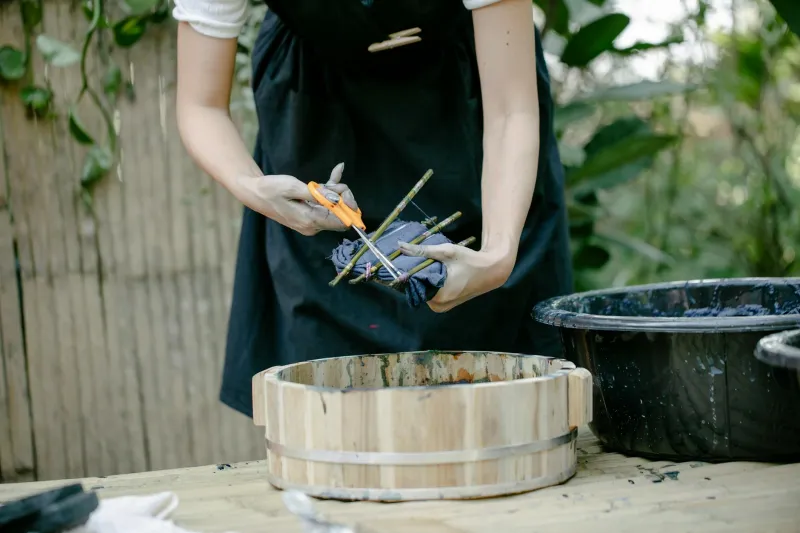
The science behind natural dyeing is fascinatingly complex, yet the process feels wonderfully primitive. In her converted barn workshop, Sarah transforms her foraged treasures through a dance of heat, time, and intuition that her great-grandmother would recognise.
"Every batch is different," she explains, stirring a pot that's releasing the earthy scent of walnut hulls. "The weather when I picked them, the pH of our Yorkshire water, even the mood I'm in – it all affects the final colour. You can't control it completely, and that's the beauty."
This unpredictability is precisely what draws people to naturally dyed pieces. When you slip on a jumper dyed with Sarah's elderberry purple, you're wearing not just a colour, but a specific September morning, the particular sweetness of that year's fruit, the exact temperature of her dye bath.
From Highlands to Harbours
Across Britain, these colour alchemists are finding inspiration in the most unexpected places. In the Scottish Highlands, Flora MacLeod harvests lichen from ancient stone circles, creating ethereal pinks and oranges that seem to hold the very essence of Highland sunsets.
"The old crofters knew these secrets," Flora tells me over the phone, her voice carrying the soft lilt of the Outer Hebrides. "My grandmother could look at a piece of cloth and tell you exactly which hillside the colours came from. I'm trying to keep that knowledge alive."
Meanwhile, down on the Cornish coast, marine biologist turned dyer Tom Penhaligon is creating extraordinary blues and greens from seaweed collected after storms. His workshop, perched on the cliffs above Porthcurno, feels like the edge of the world – and his colours capture that wild, elemental energy.
"The sea gives me everything," Tom says, holding up a skein of yarn the exact shade of a Cornwall morning sky. "Dulse for deep reds, bladderwrack for warm browns, and after the big storms, I find treasures washed up that most people wouldn't look twice at."
The Slow Fashion Revolution
What started as a handful of passionate individuals has grown into something approaching a movement. Britain's independent dyers are quietly revolutionising how we think about colour, sustainability, and our connection to place.
Unlike their mass-produced counterparts, these naturally dyed pieces tell stories. The indigo blue might come from woad grown in Somerset fields, connecting you to the same plant that painted ancient Britons. That warm terracotta could be from iron-rich clay found in the Forest of Dean, carrying the essence of ancient woodlands in its fibres.
"When someone wears my colours, they're carrying a piece of Dartmoor with them," explains Jenny Thornton, whose workshop sits in the shadow of the famous tors. "It's not just clothing – it's a relationship with the landscape."
The Art of Patient Beauty
Perhaps what's most striking about these makers is their relationship with time. In an age of instant everything, natural dyeing demands patience, respect, and acceptance of nature's rhythms.
Mordanting – the process of preparing fibres to accept dye – can take days. Some colours require multiple dips, others need weeks of sun-fading to reach their full potential. It's the antithesis of fast fashion, and that's entirely the point.
"I work with the seasons," Sarah explains, showing me jars filled with carefully preserved plant materials. "Spring brings fresh greens from new growth, summer gives me the brightest flowers, autumn offers the richest berries, and winter? Winter teaches patience."
Wearing the Landscape
There's something profoundly moving about slipping on a naturally dyed piece. It's not just the knowledge that it's been created without harmful chemicals, though that matters. It's the deeper connection – to place, to season, to the hands that made it.
When you wear Flora's Highland pink, you're wrapping yourself in Scottish mist and heather. Tom's ocean blues carry the salt tang of Cornish storms. Sarah's moorland purples hold the essence of Yorkshire's wild spaces.
"It's about bringing people closer to nature," Flora reflects. "In our urban world, we've lost that connection. But when you wear something dyed with plants from a specific hillside, picked on a particular morning, you're carrying that place with you."
The Future is Beautifully Uncertain
As I write this, I'm wearing a scarf dyed with madder root by a maker in the Cotswolds. The red isn't uniform – it shifts from deep crimson to soft coral, carrying the story of its creation in every thread. It's imperfect, unrepeatable, and absolutely beautiful.
This is what Britain's colour alchemists understand that the fashion industry is only just beginning to grasp: true luxury isn't about perfection or predictability. It's about connection, story, and the irreplaceable magic of human hands working with nature's gifts.
In a world increasingly dominated by the artificial, these makers remind us that the most extraordinary colours have always been hiding in plain sight – in our hedgerows, on our shores, beneath our feet. They're not just dyeing fabric; they're weaving our landscapes into wearable poetry, one glorious, imperfect hue at a time.