When Dreams Take Shape in Everyday Spaces
There's something utterly enchanting about the story that begins with "I started making these at my kitchen table." It's a tale we hear time and again across Britain's thriving handmade community, yet each version feels wonderfully unique. Perhaps it's because these stories speak to something deeply human – the desire to create something meaningful with our own hands, to build something that matters.
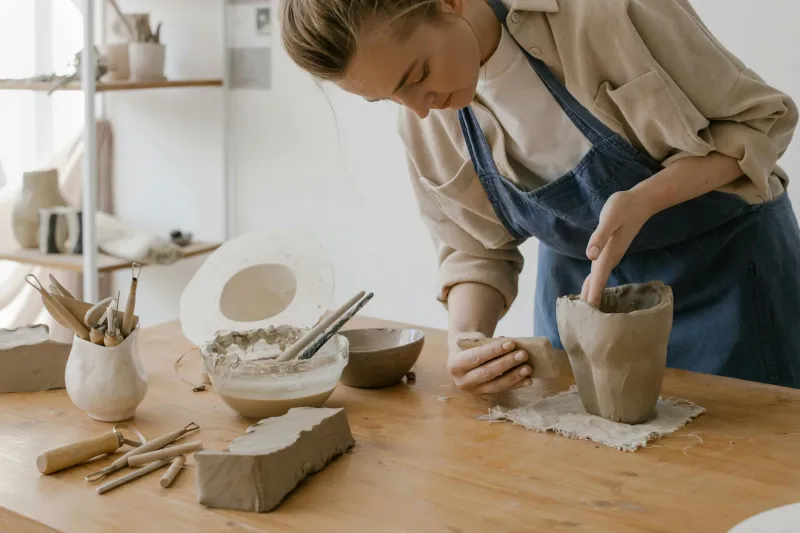
Sarah Mitchell from Cornwall knows this feeling intimately. What began as evening pottery sessions in her tiny flat has blossomed into Tide & Clay, a ceramics studio that now employs three local artisans. "I remember my first successful bowl," she laughs, "I was so chuffed I couldn't sleep. My partner thought I'd gone mad, photographing it from every angle at midnight."
The Beautiful Messiness of Beginning
The early days of any handmade business are rarely Instagram-worthy. There's clay under fingernails, yarn tangled around furniture legs, and the constant dance of creativity meeting practicality. Emma Thompson, whose hand-knitted children's jumpers have become a sensation through her brand Little Lambkins, recalls those first months with fond exasperation.
"My lounge looked like a wool explosion," she says. "I'd be packaging orders while my toddler napped, praying the Royal Mail wouldn't judge the slightly wonky labels I'd handwritten at 2am." But it's precisely this authentic beginning that customers connect with – the knowledge that real hands, real hearts, and real stories are woven into every piece.
Finding Your Rhythm in the Chaos
The transition from hobby to business isn't just about scaling up production; it's about discovering what makes your work special in a world saturated with mass-produced alternatives. Manchester-based candlemaker James Wright of Ember & Wick learned this lesson when he nearly gave up after his first Christmas market.
"I'd spent weeks perfecting my candles, only to watch people walk past for cheaper alternatives," he remembers. "But then one woman stopped, inhaled deeply, and said my lavender candle reminded her of her grandmother's garden. She bought six on the spot and came back the next day with her sister. That's when I realised I wasn't just selling candles – I was selling memories, moments, connections."
The Practical Magic of Growing Slowly
British makers often speak about the importance of growing at their own pace, resisting the pressure to scale quickly. This philosophy isn't just romantic idealism; it's practical wisdom. Lucy Chen, whose geometric jewellery brand Angles & Light has gained a devoted following, deliberately kept her day job for the first two years.
"Everyone kept asking when I'd go full-time, as if that was the only measure of success," she explains. "But I loved having the security to experiment, to say no to orders that didn't feel right, to maintain the quality that made people fall in love with my work in the first place."
When Passion Meets Persistence
The romanticised version of turning passion into profit often glosses over the gritty reality: the 4am packing sessions, the social media learning curve, the moments of doubt when orders dry up. Yet it's often these challenges that forge the strongest businesses.
Tom and Anna Bradley, the husband-and-wife team behind Hedgerow Home (specialising in foraged botanical prints), nearly quit after their first year. "We'd invested everything and barely broken even," Tom admits. "But our customers kept telling us how our prints brought nature into their city flats, how they felt more connected to the British countryside through our work. We realised we weren't just selling art – we were selling a feeling, a connection to something larger."
The Ripple Effect of Choosing Handmade
What strikes you when speaking with these makers is how their businesses have become part of their communities' fabric. Sarah's pottery studio now offers evening classes for locals. Emma's knitting patterns have created an online community of parents sharing their makes. James's candle workshops have become monthly social events in his neighbourhood.
Building Something That Lasts
The most successful kitchen-table-to-craft-empire stories share common threads: they start with genuine passion, grow through authentic connection with customers, and flourish when makers stay true to their original vision while adapting to change.
As Lucy from Angles & Light puts it: "Success isn't just about profit margins or Instagram followers. It's about creating something that brings joy to both maker and buyer, something that adds a bit of sparkle to the everyday."
Your Turn to Begin
If you're reading this with a half-finished project tucked away in a drawer, or a creative dream you've been nurturing quietly, remember that every beloved British brand started exactly where you are now. With love, determination, and perhaps a kitchen table sturdy enough to support both dreams and reality.